
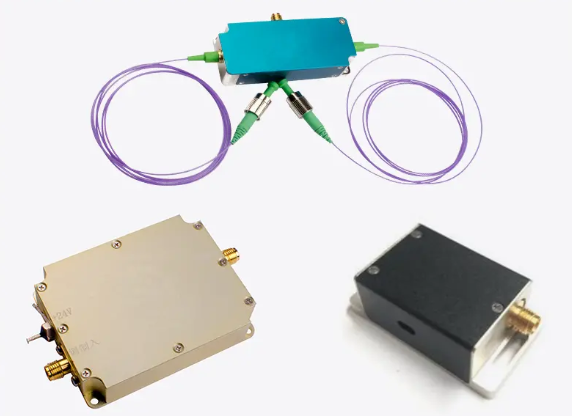
The reliability and stability of Fiber AOMs (Space Acousto-Optic Modulators) for long-distance communication are crucial considerations. While they offer significant advantages for bandwidth enhancement, there are factors to evaluate for their long-term performance:
Factors Promoting Reliability and Stability:
- Material Selection:Space AOMs typically use crystals or glasses specifically chosen for their excellent optical properties and stability. These materials exhibit minimal changes in their refractive index over time and temperature variations, ensuring consistent modulation performance.
- Design and Manufacturing:Well-designed and precisely manufactured AOMs can achieve high reliability. This includes factors like efficient acoustic wave generation and minimal acoustic wave scattering within the material. A well-designed AOM minimizes internal power dissipation which can contribute to long-term degradation.
- Environmental Control:In some cases, implementing environmental controls can further enhance stability. For instance, maintaining a constant operating temperature can minimize thermal drift and ensure consistent performance. Active thermal management systems may be necessary for high-power applications.
Potential Challenges to Reliability and Stability:
- Acoustic Wave Power:Driving the AOM with excessive acoustic wave power can lead to degradation of the crystal or glass material over time, potentially affecting modulator performance. Careful design and operation within recommended power limits are essential.
- Laser Beam Quality:The quality of the input laser beam can impact AOM performance. Imperfections in the beam profile can lead to uneven modulation or increased insertion loss. Maintaining a high-quality laser source is crucial.
- Aging Effects:Like any electronic component, AOMs can experience some degradation in performance over their operational lifetime. This can manifest as increased insertion loss or reduced modulation depth. Regular maintenance and monitoring plans may be necessary for long-distance deployments.
Overall Reliability:
With proper design, manufacturing, operation, and potentially incorporating redundancy measures, Fiber AOMs can achieve good reliability for long-distance communication systems. Here's a key takeaway:
- Careful consideration of the factors mentioned above is essential to ensure they meet the specific demands of long-distance deployments.
Additional Considerations:
- Redundancy:For mission-critical applications, incorporating redundancy measures can be beneficial. This might involve using dual AOMs or having spares readily available for rapid replacement in case of failure.
- System Monitoring:Implementing system monitoring protocols can help detect potential issues with AOMs early on. This allows for preventative maintenance or timely replacement, minimizing downtime and ensuring reliable communication over long distances.
In conclusion, Fiber AOMs offer a compelling solution for high-bandwidth optical communication systems. However, achieving optimal reliability and stability for long-distance applications requires careful attention to material selection, design, operation, and potentially incorporating redundancy and monitoring strategies.

 Arabic
 French
 Spanish
 Portuguese
 Deutsch
 Turkish
 Dutch
 Italiano
 Russian
 Romaian
 Portuguese (Brazil)
 Greek