
Unlocking the Future of Permanent Magnets: Strategic Intelligence for the 2026 Neo Magnet Market
The global rare earth permanent magnet sector is at an inflection point. As industries from electric mobility to clean energy grapple with supply chain realignments and technological demands, the neodymium-iron-boron, or neo magnet market stands at the center of this transformation. Understanding the trajectory of this critical component is no longer optional—it is a strategic imperative for stakeholders aiming to secure competitive advantage in an increasingly polarized landscape.
Worldwide Neo Magnet Market
Our latest release, the Worldwide Neo Magnet Market 2026-2032 Research Report, delivers comprehensive intelligence designed to inform capital allocation, supply chain resilience strategies, and product roadmaps. This article serves as a primer, outlining the macro dynamics and competitive forces shaping the industry while highlighting the depth of analytical tools available to subscribers. To navigate the complexity ahead, decision-makers require more than high-level headlines; they need granular data, scenario modeling, and a clear view of the regulatory forces reshaping trade flows.
Worldwide Neo Magnet Market
Global Market Trajectory: Growth Anchored by Structural Demand
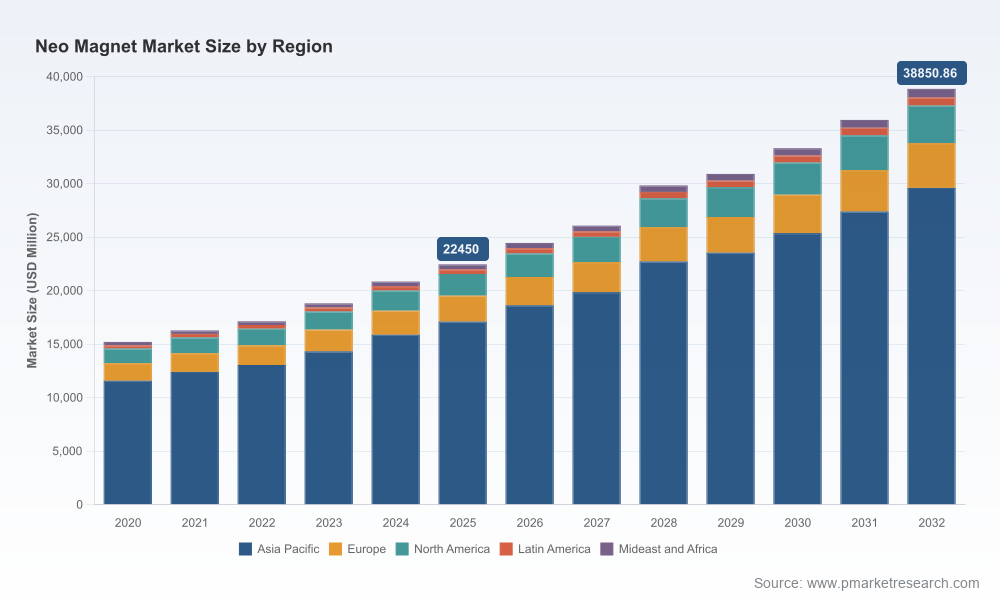
The neo magnet market has demonstrated remarkable resilience and acceleration over the past half-decade. Historical data from 2020 to 2025 reveals a consistent upward trajectory, with the global market size expanding from approximately 15.2 billion USD in 2020 to a projected 22.45 billion USD in 2025. This growth is not merely cyclical but reflects a fundamental shift in industrial and energy architectures. The forecast period from 2026 through 2032 indicates sustained momentum, with the market expected to surpass 38.85 billion USD by the end of the decade.
Worldwide Neo Magnet Market
Drivers of this expansion are deeply embedded in global decarbonization targets and electrification trends. The compound annual growth rate, calculated at 8.15 percent across the forecast horizon, underscores the sustained demand pull from sectors that rely on high-energy-density magnetic solutions. However, headline figures only tell part of the story. Revenue is distributed unevenly across geographies and application verticals, with distinct regional intensities and material specifications influencing margin structures and competitive positioning.
To capture the full nuance of this growth, analysts must look beyond the aggregate and examine the intersection of regional production capacities, end-use consumption patterns, and the interplay between sintered and bonded magnetic materials. The report dissects these layers with precision, offering a granular view of where value is being created and where vulnerabilities may emerge in the supply network.
Navigating Type and Application Segmentation
Neo magnets are broadly categorized into sintered and bonded varieties, each serving distinct functional requirements and market niches. Sintered NdFeB magnets dominate in applications demanding maximum magnetic performance and thermal stability, making them the material of choice for high-power traction motors and large-scale industrial systems. Bonded NdFeB magnets, by contrast, offer superior form flexibility and cost efficiencies for miniaturized components, playing a critical role in consumer electronics and specialized automation modules.
Applications span a diverse array of sectors, from automotive and electric vehicles to wind energy, industrial automation, consumer electronics, and medical devices. The automotive and electric vehicle segment remains the most prominent demand driver, fueling capacity expansions and technological refinements focused on high-temperature grades and reduced heavy rare earth content. Wind energy and industrial automation also contribute substantial volume, while consumer electronics and medical devices provide steady, high-precision demand streams. Each application vertical carries unique requirements for magnetic characteristics, longevity, and regulatory compliance, creating pressure points that manufacturers must navigate with agility.
The interplay between type and application is further complicated by evolving material innovations. High-coercivity grades, grain boundary diffusion technologies, and hybrid magnet designs are continuously reshaping the value proposition of different product lines. A complete strategic assessment requires detailed mapping of these technical differentiators to market demand, an analysis that the full report provides through proprietary segmentation frameworks and demand forecasting models.
Supply Chain Realignment and Raw Material Dynamics
Rare earth material pricing and availability remain foundational variables for neo magnet economics. As of late April 2026, neodymium metal prices reached 1,045,000 CNY per metric ton, reflecting a sharp year-over-year increase tied to robust magnet demand and supply constraints. Simultaneously, NdPr oxide prices in Northeast Asia hovered around 147.61 USD per kilogram in March 2026, under sustained upward pressure from constrained supply channels and the accelerating deployment of electric vehicles and wind turbines.
These price dynamics are not isolated events; they are symptoms of broader structural shifts. On the regulatory front, China implemented export controls in April 2025 on seven medium and heavy rare earth elements, including dysprosium and terbium, requiring licensing for NdFeB magnets containing these elements in high-coercivity grades. Further complicating the landscape, China’s export controls expanded in 2025 to include licensing requirements for magnets produced using Chinese-origin rare earth materials or technologies, even when manufactured by foreign firms. This extraterritorial dimension of regulatory policy is forcing multinational producers to redesign sourcing strategies and local production footprints.
Trade policy developments in North America add another layer of complexity. A 25 percent tariff on permanent magnets imported from China, including neo magnets, is scheduled to take effect on January 1, 2026. This measure is expected to incentivize reshoring and nearshoring of magnet production, stimulating investment in non-Chinese capacity while altering cost structures for downstream manufacturers. For companies reliant on imported magnets, the tariff represents both a cost headwind and a catalyst for supply chain diversification.
Recent corporate actions underscore these strategic pivots. In March 2026, MP Materials advanced its U.S. rare earth magnet supply chain expansion, scaling NdFeB production capacity targeted at electric vehicle and defense applications. Energy Fuels Inc. announced in January 2026 plans to acquire Australian Strategic Materials, strengthening integrated rare earth mine-to-metal capabilities that support NdFeB magnet supply chains. Also in January 2026, HyProMag USA completed concept studies for expansion across multiple U.S. states, targeting a recycled NdFeB magnet production capacity of 4,656 metric tons per annum by 2029. Earlier, in September 2025, Energy Fuels achieved a qualification milestone with U.S.-mined and processed NdPr oxide successfully manufactured into commercial-scale high-performance NdFeB magnets qualified for EV drive unit motors.
These developments illustrate a market in active flux, where vertical integration, recycling initiatives, and cross-border acquisitions are reshaping competitive dynamics. The report provides a systematic analysis of these initiatives, offering an assessment of their potential impact on regional supply balances, cost forecasting, and long-term competitive positioning.
Competitive Landscape: Key Players and Strategic Postures
The global neo magnet market remains moderately concentrated, with the top three firms accounting for approximately 48.2 percent of revenue and the top five capturing 62.5 percent. This concentration reflects the significant capital requirements, technical expertise, and scale advantages inherent in magnet production, but it also leaves room for specialized players and regional champions to carve out differentiated niches.
Leading Chinese producers such as Ningbo Yunsheng Co., Ltd., Beijing Zhong Ke San Huan High-Tech Co., Ltd., and JL MAG Rare-Earth Co., Ltd. command substantial capacity and serve a broad spectrum of applications spanning electric vehicles, wind power, and industrial uses. These firms have pursued aggressive capacity expansions, particularly focused on traction motors and automation, reinforcing China’s central role in the global supply chain. Ningbo Zhaobao Magnet Co., Ltd. and Zhejiang Innuovo Magnetics Co., Ltd. further strengthen the region’s production depth, offering specialized research, development, and manufacturing capabilities for industrial and automotive markets.
International competitors are responding with focused strategies to secure resilience and high-value market positions. Hitachi Metals Ltd., operating under the Proterial brand, emphasizes high-temperature grades and R&D for miniaturized and electric vehicle applications. Shin-Etsu Chemical Co., Ltd. brings vertical integration in rare earth materials and a focus on advanced high-coercivity neo grades, while TDK Corporation integrates NdFeB magnets into electronic components and motor systems, leveraging its broader electronics portfolio.
European manufacturers are deepening non-Chinese capacity to mitigate supply risks and serve regional demand. Vacuumschmelze GmbH & Co. KG (VAC) produces sintered NdFeB magnets for electric vehicles, defense, and industrial uses, actively expanding non-Chinese production capacity. Goudsmit Magnetics Group offers neodymium magnets alongside other permanent magnet types, serving a diversified European customer base. Neo Performance Materials, through its Magnequench subsidiary, produces bonded NdFeB powders and magnets with facilities supporting Western supply chains, including operations in Estonia.
In North America, a cohort of specialized and vertically integrated players is positioning for growth amid policy tailwinds. Arnold Magnetic Technologies manufactures high-performance permanent magnets, including NdFeB, for defense, aerospace, and electric vehicle applications. MP Materials Corp. continues to advance its vertically integrated rare earth strategy, scaling NdFeB magnet production capacity for electric vehicle and defense markets. Electron Energy Corporation specializes in high-temperature and high-performance neo magnets for critical applications, while Adams Magnetic Products Co. provides neodymium magnets and magnetic assemblies for industrial uses.
The competitive landscape is further shaped by the interplay of technology leadership, cost structure, and geopolitical exposure. Firms with advanced grain boundary diffusion capabilities, high-coercivity grades, and diversified sourcing strategies are better equipped to navigate raw material volatility and regulatory friction. The full report analyzes these competitive dimensions in detail, profiling each major company’s capacity, technological focus, geographic footprint, and recent strategic moves to provide a clear roadmap for competitive positioning.
Report Features: Translating Data into Actionable Intelligence
The Worldwide Neo Magnet Market 2026-2032 Research Report is structured to support a wide range of strategic use cases, from product planning and supplier evaluation to investment decisions and risk management. The report integrates historical data spanning 2020 to 2025 with a robust forecast model extending through 2032, enabling stakeholders to benchmark performance and anticipate market shifts.
Key components include:
- Market sizing and forecast: Detailed revenue projections in USD millions, segmented by region, type, and application, with clear delineation of historical baselines and forward-looking scenarios.
- Segmentation analysis: Granular breakdowns of sintered and bonded NdFeB magnets, with demand distribution across automotive and electric vehicles, industrial automation, wind energy, consumer electronics, and medical devices.
- Regional intelligence: Market size and growth profiles for Asia Pacific, Europe, North America, Latin America, and the Middle East and Africa, capturing regional demand intensities and supply chain characteristics.
- Competitive profiling: In-depth company analyses covering capacity, product focus, geographic reach, and recent strategic developments for major global producers.
- Raw material and cost dynamics: Analysis of neodymium metal and NdPr oxide pricing trends, supply constraints, and implications for magnet manufacturing economics.
- Regulatory and trade policy impacts: Evaluation of export controls, tariff schedules, and licensing frameworks, including the effects of 2025 and 2026 policy changes on supply chain strategies.
- Scenario modeling: Forward-looking assessments that consider alternative demand trajectories, capacity expansion timelines, and regulatory outcomes to support stress-testing of business assumptions.
By combining macro-level market sizing with micro-level competitive and regulatory analysis, the report equips decision-makers with the context needed to identify opportunities, mitigate risks, and align strategies with the evolving structure of the neo magnet market.
Strategic Implications for 2026 Decision-Making
As the market moves through 2026, several strategic imperatives emerge. First, the convergence of electrification, renewable energy deployment, and industrial automation will sustain demand for high-performance neo magnets, but the composition of demand will shift across applications and regions. Companies must anticipate these shifts and align product portfolios accordingly. Second, raw material constraints and pricing volatility will continue to influence cost structures, reinforcing the value of vertical integration, long-term supply agreements, and recycling initiatives. Third, regulatory developments—including export controls, tariffs, and licensing frameworks—will accelerate supply chain diversification and the development of non-Chinese production capacity, creating both opportunities and challenges for participants navigating this transition.
In this environment, access to reliable, forward-looking intelligence is critical. The Worldwide Neo Magnet Market 2026-2032 Research Report provides the analytical foundation to make informed decisions, whether the objective is to evaluate market entry, assess competitor moves, optimize sourcing strategies, or forecast revenue potential across segments.
Comprehensive data tables, regional and segment-level forecasts, and detailed company profiles are available in the full report. Readers seeking complete quantitative insights and proprietary scenario analyses are invited to access the source webpage for the complete intelligence package.
For detailed analysis of this topic, please visit the official page:Worldwide Neo Magnet Market
Lacy Lee
Senior Marketing Manager
sales@pmarketresearch.com
00852-95632430
PW Consulting: www.pmarketresearch.com

 Arabic
 French
 Spanish
 Portuguese
 Deutsch
 Turkish
 Dutch
 Italiano
 Russian
 Romaian
 Portuguese (Brazil)
 Greek