
Navigating the Evolving Landscape of Laboratory Swabs: Strategic Intelligence for 2026 Decision Makers
Executive Overview: Why Market Intelligence Matters Now
The laboratory swabs market stands at a critical inflection point. As diagnostic protocols grow more sophisticated and regulatory frameworks tighten, organizations that make procurement, manufacturing, or investment decisions without comprehensive market intelligence risk strategic misalignment. PW Consulting's latest Laboratory Swabs Market Research Report delivers the granular analysis required to navigate this complex environment with precision. This article previews the strategic architecture of our full study, illustrating how evidence-based forecasting and competitive mapping can inform decisive action throughout the 2026-2032 forecast horizon.
Laboratory Swabs Market
Industry stakeholders increasingly recognize that historical demand patterns no longer provide reliable guidance. The convergence of molecular diagnostics expansion, post-pandemic supply chain recalibration, and heightened quality management expectations has fundamentally altered how laboratory consumables are sourced, manufactured, and deployed. Our research is structured to cut through this complexity, offering decision makers a clear line of sight from macroeconomic indicators to actionable operational strategies.
Laboratory Swabs Market
Market Trajectory: Growth Vectors and Structural Shifts
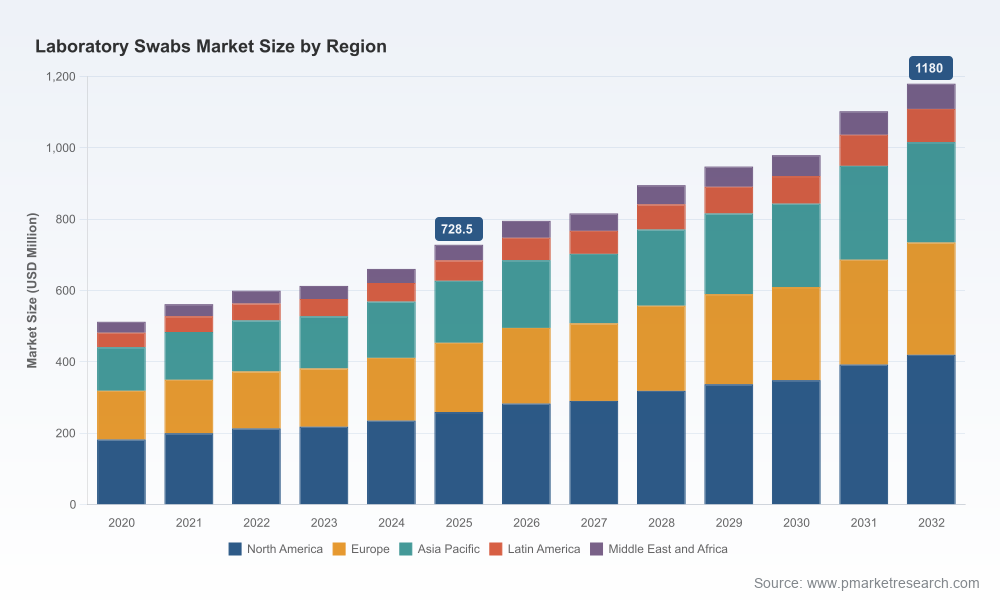
The global laboratory swabs market has demonstrated sustained expansion over the past half-decade, reflecting the enduring importance of specimen collection, microbiological testing, and environmental monitoring in both clinical and research settings. From a market valuation of approximately 512.45 million USD in 2020, the sector climbed to 728.5 million USD by 2025, marking a compound annual growth trajectory that underscores consistent demand acceleration. Looking ahead, our forecast models project the market will reach 795.58 million USD in 2026 and continue its upward march to approximately 1,180.0 million USD by 2032, supported by a forecasted CAGR of 7.15 percent.
Laboratory Swabs Market
This growth is not merely incremental; it represents a structural recalibration driven by several interrelated forces. Laboratories are increasingly standardizing on high-performance collection devices that minimize specimen degradation and improve downstream analytical reliability. Simultaneously, the proliferation of decentralized testing models and point-of-care integration has broadened the addressable user base for specialized swabs. Our report dissects these demand drivers across multiple dimensions, mapping how shifting laboratory priorities translate into concrete procurement behaviors and volume forecasts.
Importantly, the market's expansion is uneven across product categories and use cases. Flocked swabs have captured significant share due to their superior specimen release characteristics and compatibility with modern molecular workflows, while traditional cotton-tipped and foam-tipped variants maintain stable positions in specific application segments. The full study quantifies these dynamics with precise volume and value projections, enabling buyers and manufacturers to align inventory strategies with segment-specific growth trajectories rather than relying on aggregate market averages.
Segmentation Architecture: Decoding Demand by Type, Application, and Geography
Effective market strategy requires more than top-line figures; it demands a granular understanding of how value distributes across product types, end-use applications, and regional ecosystems. Our segmentation analysis provides exactly this level of granularity, examining the laboratory swabs market through three complementary lenses that together reveal where concentration lies and where white space opportunities emerge.
Product Type Dynamics
The market is anchored by several distinct swab architectures, each serving different performance requirements and cost parameters. Flocked swabs dominate the value pool, reflecting their widespread adoption in diagnostics and research workflows that require efficient capillary action and maximal sample elution. Cotton-tipped swabs retain relevance in routine cleaning and certain collection protocols, while foam-tipped variants serve niche applications where chemical compatibility or specific absorption profiles are prioritized. The remaining category encompasses specialized formulations tailored to unique environmental or procedural demands. Our report quantifies the revenue contribution and growth outlook for each type, highlighting which segments are consolidating around premium performance standards and which are experiencing price-driven volume shifts.
Application Segmentation
Specimen collection remains the dominant application driver, accounting for the largest share of total market demand as laboratories prioritize standardized, high-integrity collection protocols. Microbiological testing represents a substantial secondary pillar, fueled by ongoing surveillance requirements, antimicrobial stewardship initiatives, and the need for reliable culture and molecular sampling. Disinfection and cleaning applications, while smaller in relative terms, contribute steady demand tied to laboratory hygiene standards and environmental monitoring programs. By isolating these application streams, our research enables stakeholders to forecast volume requirements with greater accuracy and to identify cross-selling or product-line extension opportunities that generic market overviews routinely overlook.
Regional Demand Patterns
Geographic distribution of laboratory swabs demand reflects divergent healthcare infrastructure maturity, regulatory environments, and diagnostic capacity investments. North America represents the largest regional market, supported by well-established clinical laboratory networks and sustained investment in diagnostic innovation. Europe follows as a significant demand center, characterized by rigorous quality standards and strong public health surveillance frameworks. Asia Pacific exhibits dynamic growth characteristics, driven by expanding laboratory infrastructure, rising healthcare expenditure, and increasing adoption of advanced collection technologies. Latin America and the Middle East and Africa, while smaller in absolute scale, present distinct growth trajectories shaped by evolving healthcare access initiatives and targeted diagnostic capacity building. Our full report maps these regional dynamics with granular revenue estimates, enabling multinational operators to prioritize market entry or expansion strategies with confidence.
Competitive Dynamics: Navigating a Concentrated Yet Active Landscape
The laboratory swabs market features a mix of established multinational players and specialized manufacturers, with competitive intensity varying by segment and geography. Analysis of market concentration indicates a moderately consolidated landscape, where the top three firms collectively command approximately 38.5 percent of total market revenue, and the top five firms extend that reach to roughly 52.7 percent. This concentration profile suggests that while scale advantages exist, there remains meaningful room for specialized competitors to differentiate through product innovation, regulatory agility, and regional service capabilities.
Several firms define the competitive frontier through sustained investment in manufacturing capacity, product development, and regulatory compliance. Puritan Medical Products, headquartered in Guilford, Maine, remains a leading U.S. manufacturer of sterile and non-sterile swabs, flocked variants, and specimen collection devices engineered for laboratory, diagnostic, and research applications. Copan Diagnostics, based in Murrieta, California, has built a strong reputation around innovative flocked swab technologies such as FLOQSwabs, alongside transport media systems and pre-analytical solutions that streamline microbiology and specimen collection workflows. Becton, Dickinson and Company, operating from Franklin Lakes, New Jersey, provides a broad portfolio encompassing flocked swabs, ESwab systems, and sterile collection devices that support laboratory specimen transport and environmental monitoring. SARSTEDT AG & Co. KG, headquartered in Nümbrecht, Germany, offers a comprehensive range of laboratory swabs with and without transport media, serving microbiology, cytology, and diverse sample collection applications. Medical Wire & Equipment Co., based in Corsham, UK, supplies swabs and transport media solutions including Transwab and Virocult formats tailored to laboratory microbiology, virology, and environmental sampling requirements. Thermo Fisher Scientific, from Waltham, Massachusetts, delivers laboratory swabs and collection kits designed for molecular diagnostics, research, and clinical laboratory environments.
Recent corporate actions underscore the strategic intensity shaping this competitive field. In September 2025, Copan Diagnostics announced an investment exceeding 7 million USD in U.S. manufacturing expansions across California and Puerto Rico, targeting increased production of transport media kits and collection devices. Earlier that year, in May 2025, Puritan Medical Products received FDA 510(k) clearance for its PurSafe Plus Collection and Transport System, designed for microbial nucleic acid storage and stabilization. In August 2025, Copan Diagnostics launched the UriVerse fully automated solution for urine specimen aliquoting, aimed at strengthening laboratory workflow efficiency. These developments signal a market where manufacturing scale, regulatory clearance, and workflow automation are becoming decisive competitive differentiators.
Our full report maps each major competitor's product portfolio, geographic footprint, recent strategic moves, and inferred positioning strategy. This competitor intelligence allows buyers to benchmark supplier capabilities and helps manufacturers identify adjacency threats and partnership opportunities that might otherwise remain invisible in aggregate market data.
Regulatory and Operational Dynamics Shaping 2026 Strategy
Regulatory evolution represents one of the most consequential variables for laboratory swabs manufacturers and procurement teams alike. Effective February 2026, the FDA QMSR regulation, which incorporates ISO 13485:2016 by reference, became mandatory for medical device manufacturers, including those producing laboratory swabs. This regulatory alignment raises the bar for quality management system compliance and formalizes expectations around design control, risk management, and process validation. Prior to this shift, laboratory swabs have long been subject to ISO 13485 and FDA 21 CFR Part 820 compliance requirements governing quality management and product validation, but the QMSR mandate tightens enforcement coherence and increases scrutiny across the supply chain.
These regulatory expectations intersect directly with operational cost structures. Medical device manufacturers continue to navigate supply chain cost pressures tied to specialized materials such as medical-grade plastics, foam, and rayon used in swab construction. Fluctuations in raw material pricing, combined with the need for robust sterility assurance and performance validation, influence both production economics and end-user pricing. Our research quantifies how these cost drivers interact with segment-level margin profiles, helping manufacturers evaluate sourcing strategies and enabling procurement teams to assess supplier resilience under varying input cost scenarios.
It is also essential to maintain clarity regarding product classification and intended use. Laboratory swabs intended for research or diagnostic specimen collection must meet sterility and performance standards, yet they are not classified for therapeutic use. This distinction shapes labeling, marketing claims, quality documentation, and customer communication. Organizations that fail to align product positioning with regulatory classification risk compliance exposure and erode buyer trust. The full report provides detailed guidance on how leading firms structure their quality narratives and compliance documentation to satisfy both regulator expectations and informed procurement requirements.
What Our Full Report Delivers: A Practical Toolkit for Strategic Action
PW Consulting's comprehensive Laboratory Swabs Market Research Report is designed as a decision support instrument, not merely a data repository. The full document integrates quantitative forecasting with qualitative strategic analysis across the complete 2020-2032 timeline, anchored by a 2025 base year and extending through a detailed forecast period reaching 2032. Stakeholders receive a cohesive view of how historical demand evolution informs forward-looking projections and where variability factors could alter trajectory outcomes.
Key components of the report include:
- Detailed market size and growth forecasts at multiple aggregation levels, enabling scenario planning across optimistic, baseline, and conservative demand assumptions.
- Segment-by-segment revenue and volume analysis covering product types, application categories, and regional markets, with explicit identification of high-growth pockets and maturity indicators.
- Competitive profiling of major market participants, including product portfolio mapping, recent strategic actions, and inferred positioning strategies that reveal where competition is intensifying and where differentiation remains achievable.
- Regulatory and quality management analysis examining the implications of QMSR adoption, ISO 13485 alignment, and FDA compliance expectations for manufacturing operations and supplier selection.
- Supply chain and input cost assessment exploring how medical-grade materials, sterility requirements, and manufacturing scale influence cost structures and pricing dynamics across segments.
- Strategic recommendation frameworks tailored to distinct stakeholder roles, including manufacturers evaluating capacity expansion, distributors assessing portfolio optimization, and procurement teams benchmarking supplier performance and resilience.
Each section is structured to support practical application. Rather than presenting isolated statistics, the report connects data points to decision contexts, helping readers translate market intelligence into procurement plans, capacity investments, product development priorities, and risk mitigation measures. The analysis is calibrated to serve both strategic planning teams requiring horizon-level visibility and operational managers needing segment-specific guidance for near-term execution.
Translating Market Intelligence into 2026 Advantage
The laboratory swabs market rewards organizations that move beyond reactive purchasing and toward proactive, evidence-based strategy. With a forecasted CAGR of 7.15 percent and market scale projected to surpass 1,180.0 million USD by 2032, the sector offers meaningful growth potential, but that potential is distributed unevenly across segments, regions, and competitive arenas. Capturing value requires clarity on where demand is structurally expanding, which product attributes are becoming table stakes versus differentiators, and how regulatory and supply chain dynamics will reshape cost and compliance expectations over the forecast period.
Our report equips stakeholders to answer these questions with precision. Manufacturers can identify the product types and geographies most aligned with their capabilities and investment thresholds. Distributors and procurement teams can build supplier evaluation frameworks grounded in verifiable market position, regulatory readiness, and workflow compatibility. Investors and advisors can assess competitive moats, capacity expansion signals, and segment-level margin potential with a level of detail that generic industry summaries cannot provide.
The full Laboratory Swabs Market Research Report offers the complete dataset, segmentation breakdowns, competitor mapping, and scenario analysis necessary to convert market awareness into strategic advantage. We invite you to access the full report through our source webpage, where the comprehensive intelligence architecture—including detailed regional and application-level figures, granular competitor assessments, and forward-looking forecasting models—is available for immediate application to your 2026 planning cycle.
Conclusion
The laboratory swabs market is defined by steady expansion, intensifying competitive maneuvering, and an evolving regulatory environment that raises expectations for quality, validation, and supply chain transparency. As the sector moves through the 2026-2032 forecast window, organizations that ground their decisions in rigorous market intelligence will be better positioned to allocate resources efficiently, select capable partners, and respond to demand shifts with agility. PW Consulting's research is built to provide that foundation, combining macroeconomic trajectory, segmentation depth, and competitive insight into a single strategic reference. The complete report extends well beyond the preview offered here, delivering the detailed figures, segmentation splits, and analytical frameworks required to execute with confidence. We encourage stakeholders to explore the full publication to secure the intelligence needed for informed, forward-looking decisions throughout the coming forecast period.
For detailed analysis of this topic, please visit the official page:Laboratory Swabs Market
Lacy Lee
Senior Marketing Manager
sales@pmarketresearch.com
00852-95632430
PW Consulting: www.pmarketresearch.com

 Arabic
 French
 Spanish
 Portuguese
 Deutsch
 Turkish
 Dutch
 Italiano
 Russian
 Romaian
 Portuguese (Brazil)
 Greek