
Strategic Intelligence for the 2026 Enterprise: Navigating the Worldwide Information Security Market
The global information security landscape is undergoing a structural transformation that no enterprise can afford to ignore. As organizations accelerate cloud adoption, integrate artificial intelligence into core operations, and confront an increasingly sophisticated threat ecosystem, the strategic imperative to secure data, networks, and endpoints has evolved from a compliance exercise into a fundamental business driver. Our newly released Worldwide Information Security Market report delivers the analytical rigor and forward-looking intelligence required to make confident capital allocation, vendor selection, and operational security decisions throughout 2026 and beyond. This market briefing outlines the research framework, strategic themes, and competitive intelligence embedded in the full study, while demonstrating why executive leadership, security architects, and procurement strategists must anchor their planning in comprehensive, data-driven market intelligence.
Worldwide Information Security Market
The Macroeconomic Trajectory: Why Scale and Momentum Matter for Strategic Planning
The information security market has demonstrated consistent, compounding growth over the past half-decade, reflecting a global shift in how organizations prioritize risk management, regulatory compliance, and digital resilience. Historical data from 2020 through 2025 reveals a sustained upward trajectory, with the market expanding from approximately 132.5 billion USD to a baseline of 229.0 billion USD by the end of 2025. This growth underscores a broader industry reality: security investment is no longer cyclical or discretionary. It is structurally embedded in enterprise operating models, cloud migration roadmaps, and regulatory adaptation strategies.
Worldwide Information Security Market
Looking ahead, our forecast period spanning 2026 through 2032 projects a robust compound annual growth rate of 12.0 percent, with market revenue climbing steadily toward a 2032 endpoint of approximately 506.25 billion USD. This sustained momentum is not merely a function of inflation or expanded procurement. It reflects a fundamental expansion in the scope of what enterprises must protect: hybrid infrastructure, identity ecosystems, AI-driven workloads, third-party supply chains, and increasingly decentralized operational environments. For decision-makers in 2026, this trajectory carries immediate strategic implications. Budgets must be allocated with an understanding of compounding demand across multiple security layers, procurement cycles must account for vendor landscape evolution, and risk frameworks must anticipate the heightened threat surface that accompanies rapid technological integration.
Worldwide Information Security Market
Our full report unpacks how these aggregate projections translate into actionable planning parameters, including demand diffusion patterns, investment prioritization frameworks, and the evolving balance between proactive defense and reactive remediation. The complete analysis reveals how macroeconomic momentum intersects with operational realities, enabling executives to align security investment with business resilience objectives rather than treating security spending as a retroactive cost center.
Report Architecture: What the Full Study Delivers to Enterprise Decision-Makers
A credible market intelligence study must move beyond headline figures and deliver structured, operational guidance. Our Worldwide Information Security Market report is designed as a decision-support instrument, organized around the analytical dimensions that matter most to strategy, procurement, and security leadership teams. The study combines macro-level market sizing with granular segmentation, competitive benchmarking, regulatory mapping, and forward-looking scenario analysis.
Core Analytical Dimensions
- Comprehensive market sizing across historical years and multi-year forecasts, enabling trend validation and investment cycle alignment.
- Component-level analysis examining how security services, software, and hardware solutions are shaping procurement strategies and vendor relationships.
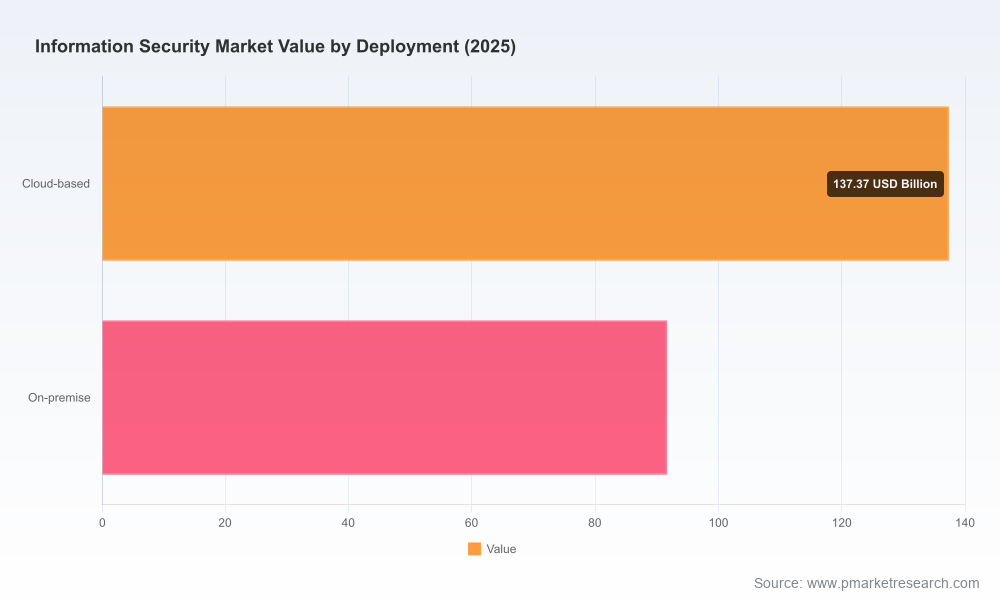
- Deployment model evaluation distinguishing the strategic considerations of cloud-based and on-premise architectures, including integration complexity, scalability, and total cost of ownership implications.
- Regional demand mapping that contextualizes where investment activity is concentrated and what localized regulatory, talent, and infrastructure dynamics mean for global enterprises.
- Competitive landscape profiling with strategic assessments of market leaders, emerging challengers, and cross-industry entrants reshaping the security vendor ecosystem.
- Regulatory and standards tracking, including how evolving frameworks, government mandates, and international certification requirements influence compliance roadmaps and vendor selection criteria.
- Technology integration analysis focused on the convergence of artificial intelligence, automation, zero-trust architectures, and threat intelligence into unified security platforms.
Operational Value for Multiple Stakeholder Functions
The report is structured to serve multiple organizational functions simultaneously. Executive leadership gains the strategic context needed to justify security investment and align risk posture with corporate objectives. Procurement and vendor management teams receive the comparative intelligence required to evaluate contract structures, licensing models, and platform interoperability. Security architects and operations leaders obtain insight into deployment trends, technology convergence, and the operational implications of platform consolidation versus best-of-breed strategies. For organizations navigating mergers, cloud transitions, or regulatory expansions, the report provides a structured reference for assessing security maturity, identifying capability gaps, and prioritizing remediation or capability acquisition.
In the full study, each analytical section is paired with practical interpretation frameworks rather than abstract data presentation. The goal is to convert market complexity into decision clarity, allowing stakeholders to identify where to invest, what capabilities to prioritize, and how to anticipate vendor and regulatory shifts before they become operational constraints.
Market Dynamics: The Forces Reshaping Information Security in 2026
The information security market does not evolve in isolation. It responds to simultaneous pressure points: escalating threat sophistication, regulatory fragmentation, workforce constraints, technology acceleration, and enterprise risk reappraisal. Our report examines these dynamics in depth, connecting external developments to internal strategic planning.
Regulatory and Standards Evolution
Regulatory expectations continue to redefine what "adequate security" means across industries and geographies. Governments and standards bodies are moving beyond high-level guidance toward enforceable frameworks that tie security maturity to contract eligibility, data handling permissions, and organizational accountability. Recent rulemaking activity has emphasized concrete maturity thresholds, supply chain risk considerations, and restrictions on data transactions involving sensitive categories of information. At the same time, internationally recognized security management standards continue to anchor enterprise governance, with growing emphasis on alignment to cloud operations, artificial intelligence governance, and privacy compliance.
For enterprises, these developments create both compliance obligations and strategic opportunities. Organizations that proactively map their security posture to emerging regulatory expectations can reduce audit friction, strengthen supplier and partner confidence, and avoid reactive remediation costs. However, the multiplicity of overlapping frameworks also introduces complexity, particularly for multinational operations managing divergent jurisdictional requirements. The full report details how regulatory trajectories are influencing procurement priorities, vendor evaluation criteria, and internal governance structures.
Artificial Intelligence and the Expanding Security Surface
The integration of artificial intelligence into enterprise workflows is simultaneously expanding the defensive capabilities of security platforms and creating new categories of risk. AI-enabled threat detection, automated incident response, and intelligent security orchestration are becoming core components of advanced platforms. At the same time, the use of AI within business processes introduces concerns around model security, data exposure, autonomous agent governance, and the potential for adversaries to weaponize similar capabilities.
This dual dynamic is accelerating vendor innovation and reshaping buyer expectations. Security leaders are increasingly evaluating platforms not only for their ability to detect and respond to known threats, but for their capacity to secure AI usage, manage emerging agentic workloads, and maintain visibility across hybrid and multi-cloud environments. The market is responding with a wave of product launches, platform enhancements, and cross-industry partnerships focused on AI-era security requirements. Our report analyzes how these developments are influencing competitive positioning, solution architectures, and enterprise adoption patterns.
Industry Investment and Strategic Consolidation
Beyond pure technology innovation, the market is experiencing strategic activity that signals how major players view the future of security operations. Large-scale acquisitions, cloud-native platform expansions, and public-private initiatives are reshaping the operational landscape. High-value transactions are extending security coverage into asset exposure management, operational technology, and specialized device ecosystems, reflecting a broader recognition that security must encompass the full spectrum of IT, OT, and connected environments.
Concurrent with consolidation, government and industry bodies are launching initiatives aimed at strengthening risk management practices, particularly in sectors where data sensitivity and systemic impact are high. These initiatives, combined with expanding enterprise spending forecasts, indicate that security investment is entering a phase where operational maturity, vendor integration, and cross-functional coordination are becoming as important as individual product capabilities. The full report places these developments within a broader market context, helping leaders distinguish between temporary market noise and durable structural shifts.
Competitive Landscape: Strategic Positioning and Market Leadership
The worldwide information security market is characterized by a mix of established infrastructure vendors, specialized security platforms, cloud-native innovators, and large technology ecosystems extending into security services and integrated protection suites. Our competitive analysis examines how leading organizations differentiate their offerings, where they compete, and how their strategic moves influence buyer decisions in 2026.
Platform Leaders and Integrated Security Suites
Several companies have built market visibility by offering comprehensive, integrated security platforms that span network defense, cloud protection, endpoint security, identity management, and security operations. These organizations emphasize unified architecture, centralized visibility, and policy consistency across heterogeneous environments. Their value propositions often center on reducing operational complexity, enabling coordinated threat response, and aligning security controls with broader enterprise IT and cloud strategies.
Within this cohort, vendors with strong networking heritage, platform breadth, and enterprise service relationships continue to influence procurement decisions, particularly in organizations seeking to consolidate tools and reduce integration overhead. Their competitive positioning increasingly depends on how effectively they combine traditional defense capabilities with AI-driven detection, zero-trust access models, and cloud workload protection.
Cloud-Native and AI-Forward Innovators
A distinct segment of the market is defined by cloud-native architectures, endpoint-focused protection, and AI-powered detection and response. These organizations compete on speed of deployment, scalability across distributed environments, and the ability to detect novel threats through behavioral analytics and automated response. Their growth has been closely tied to the shift toward remote work, distributed endpoints, and cloud-first infrastructure models, where traditional perimeter-based defenses are insufficient.
Competition in this space is intensifying as platforms expand beyond endpoint protection into extended detection and response, cloud workload security, and identity-aware access models. Buyers evaluating these providers typically focus on detection efficacy, operational automation, integration with existing security toolchains, and the degree to which platform intelligence reduces manual analyst burden. The full report includes comparative profiles that examine how these companies are positioning against one another, where they are expanding capabilities, and how their product roadmaps align with emerging enterprise requirements.
Ecosystem Expansion and Cross-Industry Entrants
The competitive field is also being shaped by large technology ecosystems and consulting-led service expansions that extend security capabilities across cloud platforms, productivity environments, and enterprise operations. These players often compete through integrated service offerings, managed security engagements, and the leverage of broader cloud, data, and productivity ecosystems. Their involvement reflects a broader market trend: security is increasingly purchased as part of broader transformation, risk management, and digital operations strategies rather than as a standalone technology purchase.
Recent product launches, platform announcements, and strategic solution introductions illustrate how aggressively companies are moving to capture emerging demand tied to AI security, agentic workload protection, and next-generation platform architectures. By mapping these moves within the competitive landscape, our report helps buyers understand which vendors are converging on similar capability sets, where differentiation still exists, and how market concentration trends may affect pricing, negotiation leverage, and long-term vendor viability.
Strategic Decision Frameworks for 2026 Enterprise Leaders
Market data becomes strategically valuable only when it is connected to decision processes. Our report translates market intelligence into practical frameworks that executive teams, security leaders, and procurement strategists can apply immediately.
Investment Prioritization and Budget Alignment
The sustained growth trajectory of the information security market highlights the importance of deliberate investment sequencing. Enterprises must balance immediate operational needs, regulatory-driven requirements, and strategic capability building. Rather than treating security spending as a uniform increase across all categories, effective organizations align budgets with risk exposure, architecture evolution, and the maturity of existing control environments. The report provides the context needed to assess where incremental investment will produce the greatest risk reduction and operational resilience.
Vendor Evaluation and Platform Strategy
As the vendor landscape matures, the question is no longer simply which product performs best in isolation, but which platform portfolio can sustainably support an organization's security operations over multiple years. Buyers are increasingly weighing platform consolidation against specialized depth, integration complexity against operational simplicity, and vendor stability against innovation speed. Our competitive analysis and segmentation insights give decision-makers the comparative basis needed to evaluate these tradeoffs with discipline rather than relying on marketing narratives or fragmented point-solution assessments.
Governance, Compliance, and Risk Communication
Regulatory expectations and standards alignment are now integral to vendor selection, internal governance, and board-level risk communication. Enterprises that can articulate their security maturity in terms aligned with widely recognized frameworks, government expectations, and industry benchmarks gain advantages in procurement, partnerships, and operational readiness. The report supports this effort by mapping the regulatory and standards environment to practical implications for security program design and external reporting.
Why the Full Report Is Essential for 2026 Planning
The market intelligence outlined in this briefing reflects the analytical foundation of a comprehensive study designed for high-stakes decision-making. Aggregate growth projections, segmentation distributions, competitive profiles, regulatory developments, and recent industry moves all point to a market that is expanding in scale, complexity, and strategic importance. However, the true value of the research lies in the integrated analysis that connects these elements into actionable guidance.
The full report provides the detailed segmentation breakdowns, regional demand contexts, component-level investment patterns, deployment model comparisons, and competitive benchmarking required to move from general awareness to precise planning. It enables organizations to assess where demand is concentrated, how provider strategies are evolving, and which market signals warrant immediate attention versus longer-term monitoring. By synthesizing macro trajectory with operational and competitive detail, the study supports a wide range of decisions: security budget formulation, vendor shortlisting, platform architecture planning, risk governance design, and strategic response to emerging regulatory and technology shifts.
For leaders responsible for enterprise resilience in 2026, incomplete market intelligence creates avoidable risk. Reliance on fragmented data, outdated forecasts, or generic industry commentary can lead to misaligned procurement, underestimated integration costs, and security programs that lag behind the threat environment they are meant to counter. Our study is built to eliminate that uncertainty by delivering a consolidated, analytically rigorous view of the worldwide information security market and its implications for enterprise strategy.
Enterprise executives, security leaders, and procurement strategists seeking the complete dataset, full competitive profiles, segmentation detail, and operational interpretation should access the full Worldwide Information Security Market report to obtain the comprehensive intelligence required for confident 2026 planning.
For detailed analysis of this topic, please visit the official page:Worldwide Information Security Market
Lacy Lee
Senior Marketing Manager
sales@pmarketresearch.com
00852-95632430
PW Consulting: www.pmarketresearch.com

 Arabic
 French
 Spanish
 Portuguese
 Deutsch
 Turkish
 Dutch
Dutch
 Italiano
 Russian
 Romaian
 Portuguese (Brazil)
 Greek
Greek