
**Navigating the Global Automatic Ice-Glazing Machine Market: Strategic Intelligence for 2026 Decision-Makers** The global food processing equipment landscape is undergoing a profound transformation, driven by rising demand for frozen seafood, meat, and convenience foods. Within this ecosystem, automatic ice-glazing machines have emerged as a critical technology for preserving product quality, minimizing dehydration, and meeting stringent regulatory and commercial weight standards. According to our latest Worldwide Automatic Ice-Glazing Machine Market research, the industry reached a valuation of USD 401.5 million in 2025 and is projected to grow at a steady CAGR of 5.24% through the forecast period to 2032. This report delivers actionable strategic intelligence designed specifically for executives who must make high-stakes capital investment, technology adoption, and competitive positioning decisions in 2026 and beyond. As labor shortages intensify across food manufacturing regions and regulatory scrutiny on food safety and product integrity increases, the ability to deploy reliable, high-yield glazing solutions is no longer a tactical advantage but a strategic imperative. This market insight preview demonstrates why leading processors and equipment investors are turning to comprehensive, data-driven analysis to de-risk their 2026–2032 planning cycles.
The Strategic Value of Forward-Looking Market Intelligence
In an industry where equipment decisions involve multi-million-dollar commitments and technology lifecycles often exceed ten years, possessing accurate, unbiased market foresight is essential. Our 2026 edition of the Worldwide Automatic Ice-Glazing Machine Market report is engineered to support three critical categories of decision-making: capacity expansion planning, technology selection and vendor strategy, and geographic footprint optimization.
Worldwide Automatic Ice-Glazing Machine Market
By combining historical performance data from 2020–2025 with granular forecasts through 2032, the study enables leadership teams to stress-test investment scenarios against realistic growth trajectories, evolving competitive dynamics, and shifting end-user requirements. Whether a multinational seafood processor is evaluating line upgrades or a regional equipment manufacturer is assessing portfolio expansion, the report provides the independent benchmark needed to align capital allocation with future market realities.
Worldwide Automatic Ice-Glazing Machine Market
Market Drivers Reshaping the Competitive Landscape
Several powerful forces are converging to accelerate adoption of automatic ice-glazing technology. Persistent labor shortages in food manufacturing remain one of the most significant catalysts. Projections indicate that the United States alone could face 2.1 million unfilled manufacturing positions by 2030. This structural gap has elevated the priority of automation across freezing, coating, and packaging processes. Automatic glazing systems directly address this challenge by reducing manual handling, improving hygiene consistency, and minimizing worker exposure to harsh cold-storage environments.
Worldwide Automatic Ice-Glazing Machine Market
Simultaneously, stringent food safety regulations continue to raise the bar for equipment compliance. Conveyor components and product-contact surfaces must meet rigorous FDA and USDA approval standards, particularly in seafood and poultry processing. Processors are therefore seeking machines constructed from high-grade Stainless Steel 304 that deliver both corrosion resistance in cold, wet environments and full traceability for audit purposes.
Consumer and retailer expectations for consistent product appearance, minimized freezer burn, and accurate net weight further reinforce demand. Ice glazing remains one of the most effective methods to create a protective barrier against moisture loss while enhancing visual appeal. As frozen seafood and convenience food categories expand globally, processors require glazing equipment capable of delivering uniform ice coatings at high throughput with minimal water waste and precise yield control.
Technology Evolution and Application Diversity
The automatic ice-glazing machine market has matured into two primary technological categories: spray glazing systems and immersion (or waterfall) systems. Each offers distinct operational advantages depending on product type, throughput requirements, and desired glazing thickness. Spray systems typically excel in high-speed, continuous operations for individually quick frozen (IQF) items such as shrimp, fish fillets, and shellfish. Immersion technologies, conversely, often deliver superior coating uniformity for whole fish, frozen blocks, or products requiring deeper ice encapsulation.
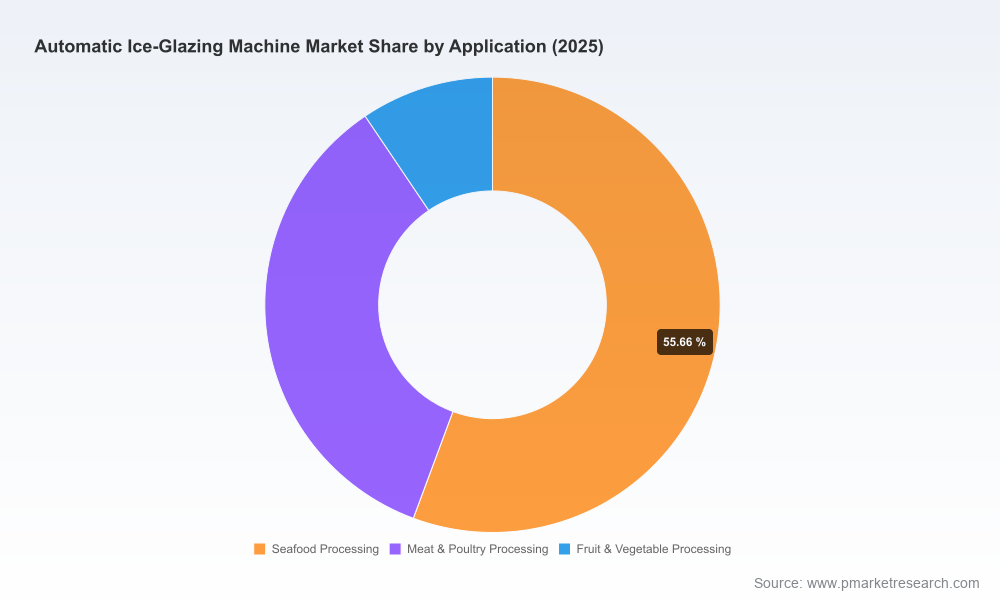
Application-wise, seafood processing continues to represent the dominant end-use segment, driven by the global expansion of aquaculture, wild-catch preservation needs, and surging international trade in frozen shrimp, fish, and value-added seafood items. Meat and poultry processors are increasingly adopting glazing solutions to protect premium cuts and ready-to-cook products during frozen distribution. Fruit and vegetable processors represent a smaller but fast-growing niche, particularly for items destined for smoothie blends, IQF berries, and prepared vegetable mixes.
Material innovation also plays a central role. Leading manufacturers have standardized on food-grade Stainless Steel 304 construction to ensure hygiene compliance, durability in corrosive environments, and ease of cleaning. Integrated features such as water recirculation systems, filtration units, adjustable belt speeds, thermostatically controlled chilling, and precise nozzle arrays have become baseline expectations rather than premium options.
Competitive Landscape: Innovation and Geographic Specialization
The competitive field combines established European engineering excellence with agile Chinese manufacturing scale. The top five players collectively account for a significant share of global revenue, yet the market remains fragmented enough to allow continued innovation from both regional specialists and emerging challengers.
Spanish manufacturers Palinox and Josmar have built strong reputations in premium seafood processing markets. Palinox’s GL-BAS and GL-ECO models integrate built-in refrigeration systems that maintain constant water temperature without the need for added ice, offering processors precise control over glazing thickness through adjustable belt speed and temperature parameters. Josmar’s JM-021 spray and JM-022 immersion machines emphasize FDA- and USDA-approved conveyor belts and highly adjustable immersion times, making them popular among large-scale frozen seafood exporters.
In Northern Europe, Dutch manufacturer Makelis has carved a niche with robust stainless steel systems featuring immersion, waterfall, and spray capabilities, complete with compact chilling units and advanced filtration. Iceland-based Martak focuses on custom-engineered solutions tailored to the unique requirements of North Atlantic fish processors, incorporating ice-bin recycling, flexible nozzle arrays, and heavy-duty designs optimized for continuous operation in demanding environments.
Chinese manufacturers have rapidly scaled their presence by combining competitive pricing with increasing technical sophistication. Tianjin Sure International has established itself as a leading supplier of automatic glazing lines for fish and shrimp, emphasizing water-saving circulation systems, uniform coating control, and full food-grade construction. GELGOOG’s GG-30 model, capable of 500–1000 kg/h throughput, is specifically engineered to achieve consistent 20–30% glazing rates on shrimp, fish, and clams while enhancing both appearance and final product weight. Other notable players including Tianjin Hitrees, Zhengzhou Wenming Machinery, and Wuye Machinery (IQFJS) continue to expand their portfolios with high-speed, energy-efficient systems integrated into broader quick-freezing solutions.
Recent developments underscore the dynamic nature of competition. In late 2024, Palinox refreshed technical documentation for its flagship GL-BAS and GL-ECO platforms, reinforcing focus on built-in refrigeration advantages. In 2026, Tianjin Sure International released an influential purchasing guide that highlights critical decision factors including capacity planning, food safety compliance, and customization potential—further evidence that vendors are shifting from pure equipment supply toward consultative solution partnerships.
What the Full Report Delivers: Actionable Intelligence Beyond Public Data
This preview only scratches the surface of the strategic intelligence contained in the complete Worldwide Automatic Ice-Glazing Machine Market research. The full study provides executives with:
- Comprehensive value chain mapping from raw material suppliers through equipment manufacturers to end-use processors
- Detailed competitive benchmarking of over 20 global and regional players, including technology portfolios, manufacturing footprints, and recent strategic moves
- Granular growth forecasts segmented by machine type, primary application, and key geographic markets
- Technology trend analysis covering next-generation features such as AI-enabled yield monitoring, IoT connectivity for predictive maintenance, and advanced water recycling systems
- Risk assessment frameworks for capital investment decisions, including scenario modeling around raw material price volatility, labor cost inflation, and evolving regulatory requirements
- Procurement best practices and vendor evaluation matrices designed to reduce total cost of ownership while maintaining food safety and performance standards
The report further examines how macroeconomic trends, sustainability pressures, and evolving cold-chain logistics requirements will influence equipment specifications and purchasing behavior through 2032. Particular attention is paid to the interplay between automation adoption, labor dynamics, and regulatory compliance across different maturity levels of regional food processing industries.
Why 2026 Represents a Critical Decision Window
The coming year stands as a pivotal inflection point. With the market poised to surpass USD 438 million in 2026 and maintaining consistent mid-single-digit growth thereafter, processors and equipment suppliers alike face strategic choices that will determine competitive positioning for the next decade. Companies that invest in the right technology platforms, partner with vendors offering genuine application expertise, and align their glazing capabilities with evolving customer and regulatory demands will secure meaningful advantages in yield optimization, product quality, and operational resilience.
Conversely, organizations relying on anecdotal market information or outdated supplier claims risk making suboptimal capital allocations in an increasingly technical and compliance-driven environment.
Our Worldwide Automatic Ice-Glazing Machine Market report is specifically designed to eliminate that uncertainty. By delivering independent, comprehensive, and forward-looking analysis, it equips decision-makers with the clarity required to act with confidence in 2026 and beyond.
To access the complete research, including full datasets, vendor profiles, regional deep-dives, and strategic recommendation frameworks, visit the official report page. The insights contained within represent not merely market data, but a strategic roadmap for sustainable success in the evolving world of automated food preservation technology.
(Word count: 1,378)
For detailed analysis of this topic, please visit the official page:Worldwide Automatic Ice-Glazing Machine Market
Lacy Lee
Senior Marketing Manager
sales@pmarketresearch.com
00852-95632430
PW Consulting: www.pmarketresearch.com

 English
 Arabic
 French
 Spanish
 Portuguese
 Deutsch
 Turkish
 Dutch
 Italiano
 Russian
 Romaian
 Portuguese (Brazil)