
Navigating the Next Frontier: Strategic Insights into the Worldwide Cryosurgical Units Market Through 2032
The global medical device landscape is undergoing a profound transformation, driven by aging populations, the rise of minimally invasive procedures, and an increasingly complex regulatory environment. Within this shifting terrain, cryosurgical units (CSUs) have emerged as a critical toolset for precise tissue destruction across multiple clinical specialties. As healthcare providers seek alternatives to traditional excision and thermal ablation, the demand for reliable, certified, and versatile cryogenic systems continues to accelerate. Our latest comprehensive study, Worldwide Cryosurgical Units (CSUs) Market, offers a granular examination of this trajectory, providing decision-makers with the intelligence needed to navigate investment, product development, and market entry strategies through 2032.
Worldwide Cryosurgical Units (CSUs) Market
This market research is not merely a retrospective of past sales figures. It is a forward-looking strategic compass designed specifically for executives, product managers, investors, and policy analysts who must anticipate inflection points before they materialize. By synthesizing historical performance from 2020 through 2025 with a robust forecast period extending to 2032, the report delivers a nuanced understanding of revenue trajectories, competitive positioning, and the structural forces reshaping the industry. The following analysis outlines the strategic value of this research and demonstrates how it equips organizations to make high-confidence decisions in an environment defined by both opportunity and regulatory complexity.
Worldwide Cryosurgical Units (CSUs) Market
Macro Trajectory and the Foundation for Strategic Planning
Understanding the broader revenue landscape is the first step toward formulating an effective market strategy. Over the past half-decade, the worldwide cryosurgical units market has demonstrated steady expansion, reflecting sustained clinical adoption and the gradual integration of cryotherapy into standard treatment protocols. Revenue figures for the historical period show a consistent upward slope, with the market crossing several meaningful thresholds as healthcare systems increasingly prioritize outpatient and minimally invasive interventions. This growth momentum carries forward into the forecast window, where the market is projected to reach new valuation peaks by the early 2030s.
Worldwide Cryosurgical Units (CSUs) Market
The compound annual growth rate observed across the forecast horizon underscores a durable expansion pattern rather than a transient spike. A sustained CAGR in the mid-six percent range signals that demand is being propelled by structural factors—clinical efficacy, reimbursement evolution, and technological refinement—rather than temporary regulatory pushes or pandemic-era anomalies. For strategic planners, this trajectory provides a reliable baseline against which to test internal projections, evaluate capacity expansion, and model pricing architectures. However, aggregate figures only tell part of the story. The true strategic advantage lies in dissecting how revenue flows across product architectures, clinical indications, and geographic corridors, which is precisely where this report delivers its most actionable intelligence.
Product Architectures and Application Pathways: Where Value Is Concentrated
The cryosurgical ecosystem is not monolithic. It spans a diverse array of delivery mechanisms, each tailored to distinct clinical workflows and procedural requirements. Liquid nitrogen systems continue to anchor a substantial portion of market activity, particularly in outpatient dermatology and veterinary applications, where portability, rapid cooldown times, and established clinician familiarity drive purchase decisions. Argon gas platforms represent a parallel growth vector, frequently deployed in specialized ablative procedures where precise temperature control and deeper tissue penetration are required. Nitrous oxide units maintain a dedicated niche, often selected for specific gynecological and superficial lesion treatments where their physical properties align with targeted clinical protocols.
On the application side, dermatology remains a cornerstone of cryosurgical utilization, driven by the high prevalence of cutaneous lesions, the shift toward office-based procedures, and the relative simplicity of treatment reimbursement pathways. Oncology represents another major demand engine, as cryoablation techniques gain traction for localized tumor management across prostate, renal, hepatic, and pulmonary indications. Cardiology has emerged as a rapidly evolving segment, with cryoenergy increasingly utilized for arrhythmia management and surgical ablation procedures that benefit from the tissue-selectivity and safety profile of cold-based ablation. Gynecology and a range of ancillary applications round out the clinical landscape, each contributing distinct purchasing cycles, regulatory considerations, and competitive dynamics.
Rather than presenting these segments as static snapshots, the report maps their historical evolution, quantifies their relative contributions to overall market activity, and projects how their interplay will shift as new clinical evidence, device iterations, and reimbursement policies take hold. This multidimensional segmentation analysis enables organizations to identify which product-application combinations offer the strongest near-term returns and which territories hold longer-term strategic potential.
Geographic Corridors and the Redistribution of Demand
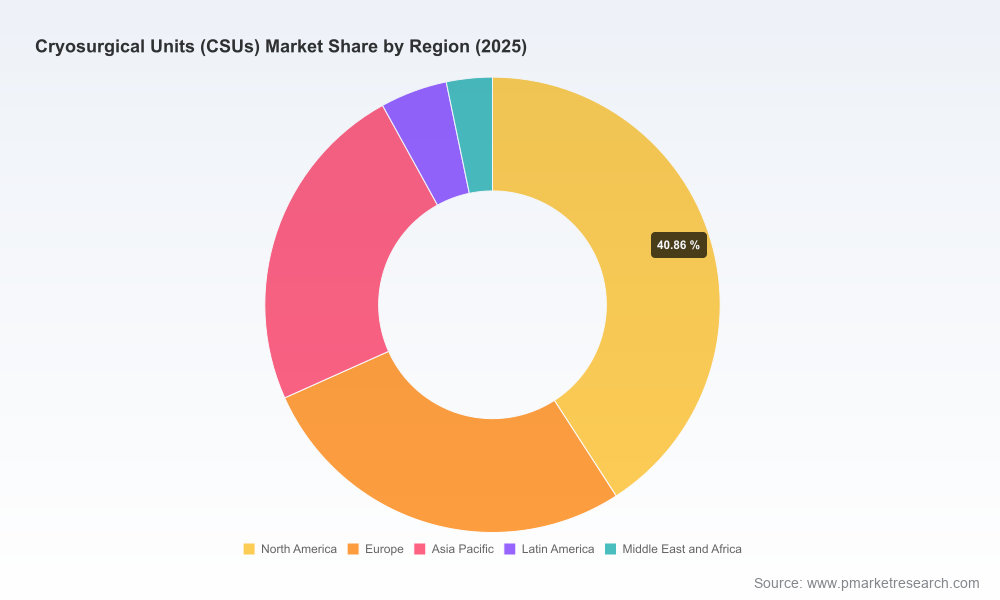
Regional market dynamics are undergoing a quiet but significant recalibration. North America continues to command a leading share of overall activity, supported by mature healthcare infrastructure, widespread adoption of office-based procedural settings, and a regulatory framework that, while demanding, provides clear pathways for market entry. Europe maintains a substantial footprint, shaped by rigorous medical device regulations, strong clinical adoption in dermatology and specialized surgical fields, and a competitive manufacturer base rooted in the region.
Asia Pacific represents a corridor of accelerating interest, where expanding healthcare access, growing procedural volumes, and increasing localization of manufacturing and distribution networks are reshaping demand patterns. Latin America and the Middle East and Africa, while representing smaller absolute contributions to global revenue, each present unique entry considerations, reimbursement structures, and procurement behaviors that can materially influence the success of international expansion strategies.
The report’s geographic analysis moves beyond broad regional labels to examine the underlying drivers of demand in each corridor, including the concentration of clinical centers of excellence, the pace of regulatory approvals, the presence of local manufacturing capabilities, and the extent to which distribution partnerships versus direct sales models drive market penetration. Organizations evaluating geographic prioritization will find this layered perspective essential for allocating commercial resources efficiently and avoiding the pitfalls of one-size-fits-all expansion assumptions.
Competitive Architecture and the Battle for Clinical Preference
The cryosurgical market features a diverse competitive field, ranging from long-established specialists with deep domain expertise to large medical technology corporations leveraging acquired cryoablation platforms. Hand-held liquid nitrogen spray systems remain a fiercely contested category, where manufacturers such as Brymill Cryogenic Systems and Cortex Technology compete on the basis of decades of field experience, ergonomic design, and regulatory certifications that support dermatology and lesion management workflows. Brymill’s continued catalog updates and Cortex’s hand-assembled, MDR-compliant CryoPro units illustrate how even mature product lines are being refined to meet evolving clinician preferences and regulatory expectations.
In the gaseous and specialized ablative segments, companies like CooperSurgical, Erbe Elektromedizin, and Zimmer MedizinSysteme bring distinct technological heritage and application-specific expertise. CooperSurgical’s Wallach and Leisegang systems maintain relevance in gynecological and general ablative procedures, while Erbe’s contact cryosurgery units and flexible cryosurgical technology address pulmonology and therapeutic tissue removal applications. Zimmer’s localized cryo blowers and handpieces serve dermatology, physiotherapy, and precision tissue treatment, demonstrating the breadth of configurations that clinicians now expect.
The oncology and cardiac ablation spaces feature a different competitive profile, characterized by high-stakes clinical outcomes, complex reimbursement considerations, and the strategic importance of acquired technology platforms. Medtronic’s cryoablation systems, including those derived from CryoCath technologies, anchor a significant presence in cardiac arrhythmia management and broader surgical cryoablation. Galil Medical, now integrated within the BTG/Varian ecosystem, continues to specialize in needle-probe cryoablation systems for tumor destruction across prostate, kidney, and liver applications. Hygea Medical Technology’s recently cleared Co-Ablation System and Medinice’s CoolCryo cryoapplicator for cardiac cryoablation highlight how newer entrants and mid-sized manufacturers are securing regulatory footholds and expanding the addressable procedural base.
At the consumer-adjacent and procedural edge, CryoSurgery’s OTC CryoFreeze device illustrates the growing interest in accessible, lower-acuity cryosurgical tools, while AtriCure’s dedicated reimbursement considerations for cardiac surgical applications underscore how coding and payment pathways can shape competitive positioning just as profoundly as device performance. The acquisition of OraSure’s Histofreezer product line by CryoConcepts and Bovie Medical’s continued listing as a cryosurgery unit manufacturer further demonstrate how intellectual property, brand recognition, and portfolio consolidation influence market structure.
The report does not merely list competitors; it evaluates their strategic posture, product pipeline implications, regulatory status, and the extent to which their offerings align with emerging clinical demand. For organizations assessing partnership opportunities, competitive threats, or potential acquisition targets, this competitive architecture analysis serves as a critical decision-support tool.
Regulatory and Reimbursement Dynamics: The Hidden Architecture of Market Access
Market growth in cryosurgery is deeply intertwined with the regulatory and reimbursement frameworks that govern device clearance and procedural payment. Cryosurgical units and accessories are regulated by the FDA as Class II medical devices under 21 CFR 878.4350 with Product Code GEH, a classification that shapes the premarket notification pathway, quality system requirements, and postmarket obligations for manufacturers operating in the United States. At the same time, European market access is governed by the Medical Device Regulation, with products such as Cortex Technology’s CryoPro units carrying MDR Class IIa certification and manufacturing within ISO 13485-certified facilities. These regulatory overlays influence not only time-to-market but also the clinical credibility and procurement eligibility of competing systems.
Reimbursement dynamics are equally consequential. Effective January 1, 2026, a new G-Code provides separate reimbursement for certain cryoablation procedures, primarily under Medicare, creating a distinct financial pathway that can materially affect hospital and ambulatory surgery center adoption. In dermatology, cryosurgery procedures for premalignant lesions are commonly billed using CPT 17000 for the first lesion, CPT 17003 for lesions two through fourteen, and CPT 17004 for fifteen or more, a coding structure that directly influences practice economics and device procurement priorities. AtriCure’s dedicated G-Code reimbursement considerations for cardiac surgical applications further illustrate how procedure-specific payment mechanisms can elevate the strategic importance of particular platforms.
Recent regulatory milestones reinforce the dynamic nature of this environment. In February 2026, Medinice S.A. received FDA 510(k) clearance for its CoolCryo Cryoapplicator and Control Console for cardiac cryoablation with a liquid nitrogen reservoir, classified as a Class II cryosurgical unit. In March 2025, CryoSurgery, Inc. secured FDA clearance for its CryoFreeze Wart and Skin Tag Remover as a Class II OTC device. In January 2025, Hygea Medical Technology obtained FDA clearance for its Co-Ablation System with sterile probes, and Brymill Cryogenic Systems released an updated product catalog in August 2025 showcasing its Cry-Ac series hand-held liquid nitrogen units. Each of these developments signals shifting competitive readiness, expanded procedural indications, or refreshed product assortments that can alter purchasing behavior and market share trajectories.
The report integrates these regulatory and reimbursement developments into a cohesive market dynamics framework, enabling readers to anticipate how clearance pathways, coding updates, and compliance requirements will influence purchasing cycles, competitive positioning, and regional adoption rates over the forecast period.
Report Structure and Actionable Intelligence for Decision-Makers
Beyond its macro and competitive analysis, the Worldwide Cryosurgical Units (CSUs) Market research is structured to deliver practical, decision-ready content across multiple dimensions of market intelligence. The study provides a detailed review of historical revenue performance, a rigorously modeled forecast through 2032, and a breakdown of how revenue distributes across product types, clinical applications, and geographic regions. These analyses are underpinned by transparent methodology and validated data sources, ensuring that strategic planners can rely on the outputs for internal modeling and board-level presentations.
The report also examines market concentration dynamics, offering insight into the degree of competitive consolidation and the share held by leading participants. Understanding the concentration profile is essential for assessing market entry barriers, pricing power, and the potential for disruption by new entrants or innovative device architectures. Complementary sections address segmentation splits, growth drivers, restraining factors, and the evolving interplay between regulatory clearance, reimbursement design, and clinical adoption.
For organizations developing new cryosurgical products, evaluating distribution partnerships, or considering geographic expansion, the report’s segmentation and competitive sections provide a structured lens for prioritizing investments. For investors and financial analysts, the historical-to-forecast revenue architecture and concentration metrics offer a foundation for valuation scenarios and risk assessments. For policy and market access professionals, the integration of regulatory classifications, coding structures, and recent 510(k) clearances creates a reference point for anticipating how future policy shifts may reshape demand.
Strategic Imperatives for 2026 and Beyond
As organizations look toward 2026 and the subsequent forecast years, several strategic imperatives emerge from the market landscape. First, aligning product portfolios with high-growth application segments and the corresponding reimbursement pathways will be critical for capturing sustained demand. Second, monitoring regulatory milestones and certification timelines across major markets can provide early signals of competitive shifts and opportunities for accelerated market entry. Third, understanding the geographic redistribution of demand will help commercial teams optimize resource allocation, tailor go-to-market models, and avoid overconcentration in mature corridors at the expense of emerging ones.
The concentration profile of the market further suggests that while established players maintain significant share, the diversity of manufacturers, the ongoing stream of FDA clearances, and the breadth of application-specific devices create space for targeted differentiation and strategic collaboration. Organizations that can combine clinical efficacy, ergonomic design, regulatory readiness, and reimbursement alignment will be best positioned to convert market growth into durable competitive advantage.
Conclusion: Converting Intelligence into Advantage
The Worldwide Cryosurgical Units (CSUs) Market research is designed to translate complex market signals into clear, actionable strategic guidance. By combining historical performance, forward-looking forecasts, segmentation depth, competitive profiling, and regulatory-reimbursement context, the report equips executives with the intelligence needed to make high-confidence decisions in a market defined by clinical innovation, regulatory evolution, and shifting geographic demand.
For organizations ready to move from observation to action, the full study provides the detailed segmentation data, regional breakdowns, application-specific revenue distributions, and concentrated competitive analysis necessary to build robust 2026 strategies and beyond. The macro trajectory outlined here offers a strong foundation, but the decisive insights—those that inform portfolio prioritization, market entry sequencing, partnership selection, and investment allocation—reside in the complete report. We invite decision-makers to access the full intelligence suite to ensure their strategic plans are grounded in the most comprehensive and current analysis of the cryosurgical units market available.
For detailed analysis of this topic, please visit the official page:Worldwide Cryosurgical Units (CSUs) Market
Lacy Lee
Senior Marketing Manager
sales@pmarketresearch.com
00852-95632430
PW Consulting: www.pmarketresearch.com

 English
 Arabic
 French
 Spanish
 Portuguese
 Deutsch
 Turkish
 Dutch
 Italiano
 Russian
 Portuguese (Brazil)
 Greek