
Navigating the Connected Classroom: Strategic Insights from the Worldwide K-12 Audio Visual System Market 2026-2032
The K-12 education sector stands at a critical inflection point. As digital transformation accelerates within school districts globally, the infrastructure supporting modern pedagogy is undergoing a profound evolution. The audio-visual systems that once served merely as projection tools are now central hubs for hybrid learning, interactive collaboration, and data-driven instruction. For executives, investors, and strategic planners operating within the education technology ecosystem, understanding the trajectory of this market is no longer optional—it is a prerequisite for informed capital allocation and product roadmapping.
Worldwide K-12 Audio Visual System Market
PW Consulting is pleased to introduce our latest comprehensive research study: the Worldwide K-12 Audio Visual System Market. This report is designed not merely as a statistical summary, but as a strategic compass for navigating the complexities of the 2026-2032 forecast period. By integrating historical performance data from 2020 through 2025 with forward-looking analysis, this study provides the granularity required to anticipate shifts in demand, competitive positioning, and regulatory influence.
Worldwide K-12 Audio Visual System Market
The Macro Economic Landscape: Growth and Trajectory
The global appetite for K-12 audio-visual solutions has demonstrated remarkable resilience and expansion over the past five years. Our analysis indicates a total market valuation that has climbed steadily from approximately USD 15.82 billion in 2023 to reach USD 18.50 billion by 2025. This growth is not merely a rebound from pandemic-era disruptions but reflects a structural shift in how educational environments are designed and funded.
Worldwide K-12 Audio Visual System Market
Looking ahead, the momentum is projected to sustain a Compound Annual Growth Rate (CAGR) of 8.52 percent throughout the forecast period. By 2032, the worldwide market revenue is expected to surpass USD 32.79 billion. This trajectory underscores a fundamental reality: schools are increasingly viewing AV systems not as discretionary expenses, but as essential utilities comparable to connectivity infrastructure. However, these aggregate figures only tell part of the story. The distribution of this growth across components, deployment types, and regional jurisdictions offers deeper clues regarding where strategic opportunities lie. Our full report dissects these vectors in detail, allowing stakeholders to move beyond top-line numbers to identify high-yield niches.
Component Dynamics: The Shift Toward Integration
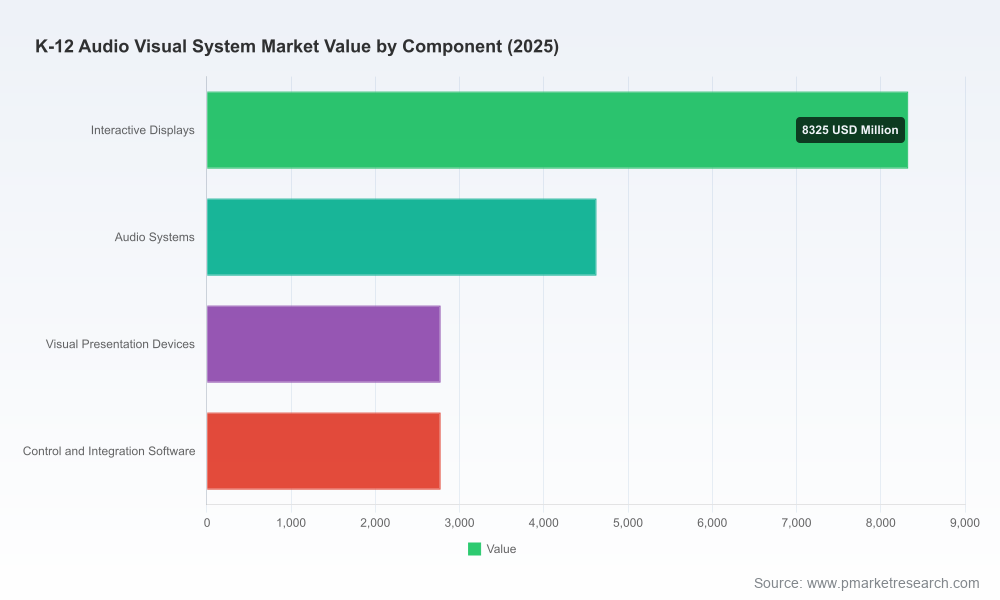
The architecture of K-12 AV systems is becoming increasingly sophisticated. The market is no longer dominated solely by hardware playback; it is driven by the convergence of visual clarity, audio fidelity, and control intelligence. Within the component landscape, interactive displays have emerged as a dominant force, reflecting the pedagogical shift toward student-centric, touch-enabled learning environments. These devices are no longer static whiteboards but intelligent endpoints capable of running applications, storing lessons, and connecting to cloud ecosystems.
Audio systems remain a critical pillar, particularly as voice amplification and clear intelligibility become linked to student performance metrics, especially in larger or acoustically challenging classrooms. Meanwhile, visual presentation devices continue to evolve, with laser projection and ultra-short-throw technologies challenging traditional lamp-based models. Perhaps most significantly, the segment for control and integration software is gaining traction. As districts seek to manage fleets of devices across multiple buildings, the ability to centralize control, automate power sequences, and integrate with learning management systems is becoming a key differentiator for vendors.
Our report provides a granular breakdown of how these components interact within budgetary constraints. We analyze how procurement decisions are shifting from standalone hardware purchases to bundled solutions that offer long-term operational efficiency. Understanding the price elasticity and adoption curves for each component is vital for manufacturers and integrators aiming to align their product portfolios with district purchasing behaviors.
Deployment Environments: Public vs. Private Sector Drivers
The purchasing dynamics of public schools and private institutions diverge significantly, influenced by funding mechanisms, regulatory compliance, and decision-making hierarchies. Public schools, which represent the larger share of the deployment base, operate under stringent budgetary cycles often tied to government grants, E-rate funding, and bond measures. Their procurement processes prioritize durability, compliance with accessibility standards, and total cost of ownership over the lifecycle of the equipment.
Private schools, while smaller in aggregate volume, often exhibit faster adoption cycles for premium features and specialized immersive technologies. They may be more agile in adopting AI-driven tools or high-end audio configurations that support specialized curricula. Our analysis explores these distinct behavioral patterns, offering insights into how vendors can tailor their sales strategies and value propositions to resonate with the specific administrative cultures of each sector. Networking infrastructure plays a pivotal role here; for instance, recent sector analysis suggests that fiber installation for a typical elementary school can still cost districts approximately $20,000 after E-rate discounts on a base project nearing $200,000. Such infrastructure realities directly impact the scalability of advanced AV deployments, a factor we scrutinize closely in our deployment type segmentation.
Competitive Landscape: Key Players and Strategic Moves
The K-12 AV market is characterized by a mix of consumer electronics giants, specialized education technology firms, and infrastructure providers. The competitive intensity is moderate to high, with a consolidated top tier. Our data indicates that the top three players hold a combined market share of 35.4 percent, while the top five control 48.2 percent of the market. This concentration suggests that while scale advantages exist, there is ample room for specialized players to compete on innovation and integration expertise.
Samsung Electronics continues to reinforce its position with a strong focus on interactive displays and digital signage solutions tailored for K-12 classrooms. Their recent trajectory highlights a pivot toward AI-driven models that support hybrid and immersive learning environments. In January 2026, Samsung introduced AI-driven interactive displays, specifically the WAFX-P series, featuring generative AI, real-time transcription, and Google Classroom integration. This move signals a broader industry trend where hardware vendors are embedding software intelligence directly into the classroom endpoint.
Sony maintains a reputation for high-quality visual and audio solutions, offering professional AV systems that cater to institutions prioritizing multimedia fidelity. Their strategy often complements broader ecosystem deployments where broadcast-quality output is required for special education or performing arts contexts within schools.
Cisco remains a dominant force in the networking layer that underpins connected classrooms. By delivering networking infrastructure and collaboration AV tools, they enable the hybrid learning scenarios that many districts now consider standard. Their strategy leverages the convergence of IT and AV, positioning them as a partner for districts seeking unified management of data and media traffic.
On the integration and control side, Extron Electronics and Crestron Electronics are pivotal. Extron specializes in AV signal management and classroom integration solutions, recently beginning shipment of their PlenumVault Direct View System for classroom flat panel displays, supporting K-12 AV integration. Crestron provides integrated control and AV systems for smart classrooms, supporting interactive and automated learning in K-12 districts. Their focus on automation reduces operational burdens for school IT staff, a key selling point in labor-constrained environments.
Japanese manufacturers such as Panasonic and Epson continue to supply durable projectors, displays, and AV solutions optimized for education. Epson, known for interactive projectors and their BrightLink series, remains a strong contender for classroom projection and touch interactivity, often offering a cost-effective alternative to large-format touch panels. NEC also contributes large-format displays and AV solutions for educational facilities, supporting high-engagement K-12 environments.
Specialized education technology firms like Promethean and Boxlight focus deeply on the instructional ecosystem. Promethean focuses on interactive displays and software ecosystems, such as ActivInspire, for collaborative K-12 instruction. Boxlight offers Clevertouch interactive displays and full classroom AV technology suites for K-12 schools. Their depth of software integration often creates stickiness with teachers and administrators alike.
Audio-specific players are equally critical. Polycom (HP) delivers audio and video conferencing systems integrated into K-12 AV setups for hybrid learning. Shure supplies classroom audio systems, microphones, and sound reinforcement for clear voice distribution, addressing the acoustic challenges inherent in many school buildings. Biamp offers networked audio solutions and DSP systems for K-12 school-wide sound and paging integration, ensuring that audio quality scales across campuses.
Recent industry events underscore the velocity of innovation. At CES 2026, AVIXA highlighted AI calibration, wireless AV systems, and education-focused hardware innovations applicable to K-12 deployments. Furthermore, Analysts Insights released an Ed Tech Voice report on factors influencing school investments in Audio-Visual devices and planned K-12 purchases, providing additional qualitative context to the quantitative trends we track.
Regulatory and Infrastructure Headwinds
Strategic planning in this market must account for a complex web of regulatory and infrastructure realities. Funding mechanisms like E-rate remain central to public school procurement, but they come with strings attached. The Children's Internet Protection Act (CIPA) requires content filters for schools receiving E-rate funding to access federal support for broadband and related AV infrastructure. Compliance is not merely a legal checkbox; it influences the architecture of network-connected AV devices and the software layers they interact with.
Regulatory dynamics also extend to connectivity access. The FCC reinstatement of net neutrality rules aims to prevent broadband providers from throttling or creating paid fast lanes, supporting equitable access to online educational AV content in K-12 schools. This policy context ensures that AV content delivery remains unimpeded, but it also places pressure on vendors to ensure their solutions are bandwidth-efficient and robust across varying network qualities.
Cybersecurity presents a growing imperative. With 82 percent of reporting U.S. K-12 organizations experiencing cyber threat impacts between mid-2023 and the end of 2024, and average data breach costs in education at approximately $3.65 million, school districts are increasingly scrutinizing the security posture of every device on their network. AV systems, once isolated, are now IP-connected endpoints. Vendors must demonstrate robust security protocols, encryption standards, and update management capabilities to win trust. Our report evaluates how these security demands are influencing procurement checklists and vendor selection criteria.
Why This Report Matters for 2026 Decision Making
The 2026-2032 forecast period is not a continuation of the status quo. It is a period defined by the maturation of AI integration, the tightening of cybersecurity requirements, and the ongoing pressure on public budgets. For manufacturers, understanding the precise growth vectors across components and regions is essential to optimize supply chain investments and R&D focus. For integrators, knowing the deployment type preferences and infrastructure cost realities helps in crafting proposals that balance ambition with fiscal feasibility. For investors, the market concentration data and key company strategies provide a framework for assessing competitive moats and growth potential.
This study is structured to support real-world decision-making. It moves beyond abstract trends to provide actionable intelligence on market sizing, segmentation splits, and competitive profiling. We examine how the median cost per megabit for schools meeting FCC connectivity goals has declined significantly to around $0.97 by 2022, with continued downward trends through 2025 due to competition and subsidies. These connectivity economics directly enable the AV ecosystems we analyze, and understanding their trajectory is key to projecting AV adoption rates.
However, the full depth of this analysis—including the specific regional dynamics, detailed component revenue forecast over the entire period, and comprehensive competitive benchmarking—requires access to the complete dataset. The executive summary provided here offers the strategic narrative and the macro validation, but the granular tables and regional breakdowns contained in the full report are where the specific investment theses are validated.
Conclusion
The Worldwide K-12 Audio Visual System Market is entering a phase of sophisticated expansion. The convergence of hardware durability, software intelligence, and connectivity infrastructure creates a rich environment for innovation, but also raises the stakes for competitive differentiation. Stakeholders who rely on outdated market assumptions risk misallocating resources in a landscape where AI capabilities, security compliance, and total cost of ownership drive purchasing decisions.
PW Consulting's latest research study is designed to equip you with the clarity needed to navigate this complexity. By synthesizing historical performance, forward-looking forecasts, and detailed competitive analysis, we provide the intelligence necessary to formulate robust strategies for the coming years. We invite you to explore the full report to uncover the detailed segmentation data, regional insights, and specific company profiles that will complete your strategic picture. The future of the connected classroom is being built now; ensure your strategy is aligned with the realities of the market.
For detailed analysis of this topic, please visit the official page:Worldwide K-12 Audio Visual System Market
Lacy Lee
Senior Marketing Manager
sales@pmarketresearch.com
00852-95632430
PW Consulting: www.pmarketresearch.com

 English
 Arabic
 French
 Spanish
 Portuguese
 Deutsch
 Turkish
 Dutch
 Italiano
 Romaian
 Portuguese (Brazil)
 Greek